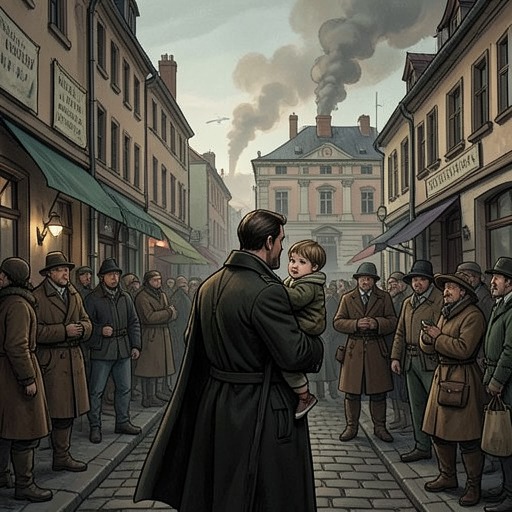
Sumner's Delhi treasure hunt and ambush
The North WaterSumner's Delhi treasure hunt and ambush begins with a promise of wealth amid the work of a field hospital. The expedition turns that promise into a trap: Sumner and his companions are attacked in a courtyard, and he must survive alone in a city where the fighting has left civilians and soldiers at risk alike.
The Offer and Expedition
A man seeking medical help offers to show Sumner and the other surgeons a buried fortune of gold and jewels, claiming it is worth two lakhs. Corbyn agrees to send three men with the stranger and to include Price, the orderly, while he remains at the hospital with the wounded boy. His terms make the venture more than an act of charity: the group is promised equal shares, with an additional tithe for Price, and the prize agents are to be kept from learning about the arrangement. Price leads them through narrow lanes and a largely deserted part of the city, past damaged buildings and signs of recent violence. At the destination, they find Hamid digging beneath a flagstone in a small courtyard. The promise of treasure has drawn the party away from the hospital and into an enclosed space, where the group’s private bargain and the apparent urgency of the search leave them exposed.
The Ambush and Flight
Hamid’s appeal for haste gives way to a silent gesture with two meanings: he raises his arms, and Patrick Sumner understands it as both refusal and surrender. A musket fires from the balcony. Price is killed, Wilkie is shot, and O’Dowd is attacked by a sepoy who has rushed into the courtyard. Sumner fires at the attacker, then makes for the street as shots continue around him; a bullet wounds his calf. The promise of a share in hidden treasure has brought the surgeons and orderly into an ambush, and the group’s hospital work is abruptly replaced by a struggle to escape the city’s violence.
Sumner leaves the street for a maze of alleys and takes shelter in a nearby house, where he finds a frightened boy lying in a dark room. He lowers himself to the floor and indicates his wounded leg, then discovers that he still has his gold ring from Delhi. Showing it to the boy, he gestures for him to take it, offering the valuable keepsake in the hope of obtaining help. The encounter shifts the immediate stakes from the failed search for treasure to a fragile attempt at mutual aid, while Sumner remains injured and cut off from his companions.
The Failed Escape and Return
Sumner and the boy make their way toward the gunfire, hoping to reach the British troops, but the battle is already moving on. In the thoroughfare they encounter a British soldier carrying a pistol and a sack of loot. He notices the boy, hesitates, then shoots him. Sumner tries to help, but the boy dies; the soldier reloads and tells Sumner that he has saved his life. The encounter overturns any expectation that reaching British soldiers will mean safety: the boy who had offered help is killed by one of the men Sumner hoped would rescue them, while the soldier presents his own violence as a debt Sumner should remember.
A dooly arrives and carries Sumner through the damaged city to the field hospital behind the racquet court. The wounded surgeon is not recognized at first among the many casualties, but Corbyn sees him and has him moved upstairs into a room by himself. Sumner receives food, water, laudanum, and care for his injured leg. The hospital’s familiar sounds of cannon fire and wounded men continue below; when Corbyn later comes to see him, he asks whether the others are dead. The treasure expedition has ended not in discovery or profit, but in the loss of its companions and Sumner’s return to the same overwhelmed medical station from which the search began.
Recollection and the Limits of Duty
The episode returns as a memory while Sumner is feverish aboard the whaling ship, moving north and west through fog, drizzle, and ice. His opiated thoughts drift away from the voyage and back to Delhi, where the field hospital had confronted him with more wounded men than its staff could treat. This shift in time makes the treasure hunt part of a larger recollection of the siege: the expedition is recalled not as an isolated adventure, but as a rupture in the work Sumner had believed he could continue by attending to one patient after another.
Before the expedition, Sumner and the other assistant surgeons worked through an unbroken sequence of cases. Corbyn, the staff surgeon, decided which injuries required immediate amputation; Wilkie and O’Dowd worked alongside Sumner, while the orderly Price helped manage the arriving casualties. Sumner’s resolve was to keep working because duty was the only available response. The expedition’s ambush reverses that arrangement: the surgeon becomes a wounded man, his companions are lost, and the capacity to help depends on escaping the fighting and reaching care himself. His return to the hospital restores him to its protection, but not to the earlier position from which he had set out.
The recollection also places Corbyn’s authority against the scale of the violence he has witnessed. His experience at Inkerman gives him a frame of comparison for the siege, yet the hospital’s continual demands leave little room for reflection; Sumner, too, has no time for anger or fear while the work continues. Remembered aboard a ship far from Delhi, the episode gathers those pressures into a single turning point: a covert promise of wealth leads away from medical duty, and the attempt to return to safety exposes both the vulnerability of the wounded and the limits of protection offered by military allegiance.